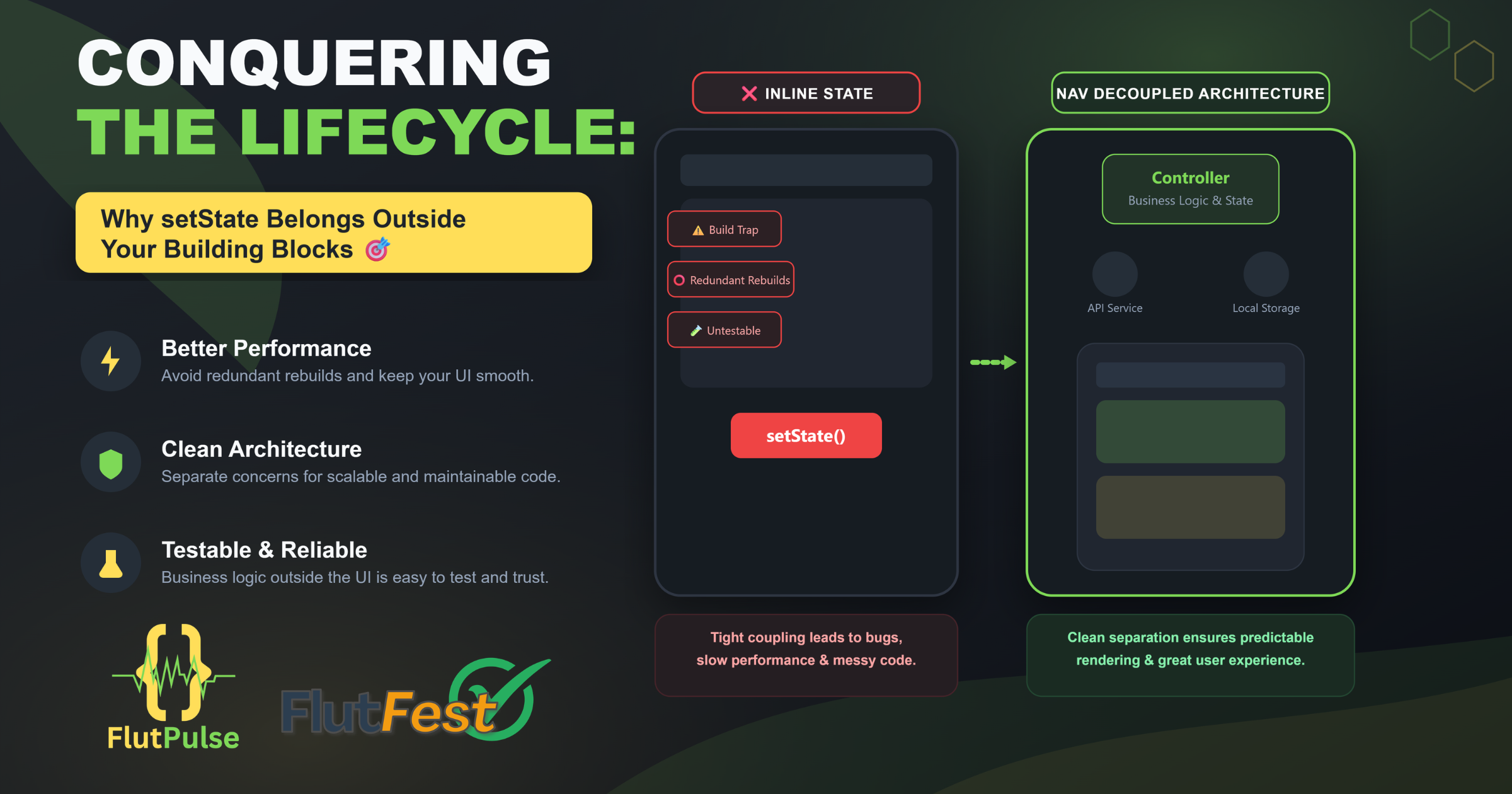
Conquering the Lifecycle: Why setState Belongs Outside Your Building Blocks 🎯
Published on: June 14, 2026
🎯 Conquering the Lifecycle: Why setState Belongs Outside Your Building Blocks
Flutter’s declarative nature is incredibly powerful, yet it introduces a common architectural trap: conflating your user interface with your business logic. 🕸️ For many developers stepping into intermediate territory, the immediate impulse to handle real-time screen updates is to trigger a local state rebuild.
While native state management tools are excellent for isolated, micro-level widget tracking, scaling a real-world application requires a much stricter separation of concerns. 🛑 When your visual views become directly responsible for tracking data streams, initializing services, or executing heavy logic computations, your codebase becomes highly brittle. Rebuilding a widget should be a side-effect of a data change, never the direct manager of it.
⚠️ The Hidden Cost of Inline State Management
Relying on direct local state triggers inside heavily nested widgets frequently leads to three architectural bottlenecks:
- 🚨 The Build-Phase Trap: Attempting to modify properties or navigate pages while the framework is actively rendering the widget tree triggers the notorious framework runtime errors. This happens because the UI is trying to draw a frame while simultaneously being told that the underlying data has changed.
- 🔄 Redundant Widget Rebuilds: Triggering a full-widget update forces every single child widget in that subtree to re-evaluate. On data-heavy screens, this unnecessary processing degrades scrolling performance and consumes excess device memory.
- 🧪 Untestable Logic: When your data processing is physically written inside a user interface class, writing automated unit tests for your application’s behavior becomes virtually impossible without rendering the entire screen layout.
To maintain a responsive interface that behaves consistently across variable device speeds, state logic must be lifted entirely out of the visual layer. 🧠
🏛️ Decoupling Logic for Predictable Rendering
True architectural freedom is achieved when your user interface widgets are entirely passive. The UI should simply look at a stream of data and display it, leaving the heavy lifting to external controllers that survive independent of the immediate widget lifecycle. 🧭
💡 Architecture Principle: “Your views should be dumb, and your controllers should be smart.” By injecting dependencies outside the rendering tree, you ensure that network calls, database updates, and data formatting happen in a predictable lifecycle container that never clashes with active UI drawing phases.
Separating your state controllers from the visual tree results in absolute layout stability, cleaner code readability, and zero unexpected UI freezes. 🚀
⚡ How FlutFest Solves It
Enforcing this clean separation without boilerplate is exactly why FlutFest is built entirely on a decoupled architecture. 🛠️
Instead of cluttering your views with logic, FlutFest utilizes structured binding files that automatically inject and dispose of controllers behind the scenes. This ensures that complex pages—such as the EventListScreen or HomeScreen—remain completely free of local state updates.
The UI simply consumes data provided by dedicated controllers, preventing active build errors entirely and guaranteeing a fluid, highly responsive user experience across your entire product. 💎
✨ Experience the fluid performance of a detached architecture live: 👉 https://ahmloutfy.github.io/FlutFestDemo/